
Afrobarometer Report: Most Africans Support Free Movement but Remain Cautious About Immigration
A new Afrobarometer report has revealed that while a majority of Africans support the free movement of people across borders, many remain cautious about immigration into their own countries, particularly when it comes to admitting job seekers and refugees.
The findings are contained in the 2026 African Insights Report, the third edition of Afrobarometer’s annual flagship publication, which explores Africans’ perceptions of the continent’s relationship with the rest of the world.
Based on 50,961 face-to-face interviews conducted across 38 African countries between 2024 and 2025, the report examines public opinion on trade, migration, global power competition, Africa’s global influence, and climate change.
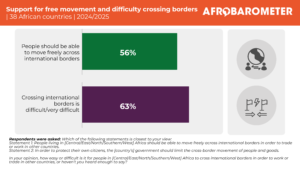
According to the report, 56 percent of Africans believe people should be able to move freely across international borders within their regions, while 40 percent prefer governments to impose restrictions in order to protect employment opportunities and other economic interests.
Despite broad support for regional mobility, only 23 percent of respondents said it is easy or very easy to cross borders for work or trade, compared with 63 percent who described the process as difficult.
The report also found that Africans are generally welcoming toward foreigners, with 77 percent saying they would either like or would not mind having immigrants or foreign workers as neighbours.
However, attitudes become more cautious when immigration is linked to employment and economic opportunities.
While 45 percent of respondents believe immigrants benefit their country’s economy, 44 percent think they have a negative economic impact. In addition, 64 percent of respondents said they would prefer their countries to admit fewer or no foreign job seekers, while 70 percent expressed similar views regarding refugees.
One of the report’s most striking findings is that, unlike trends observed in many other parts of the world, Africa’s wealthiest, most educated, and highly skilled citizens are the least supportive of admitting immigrants.
The report further indicates that migration aspirations among Africans continue to rise.
Nearly 45 percent of respondents said they had considered emigrating, including 25 percent who said they had thought about leaving their country “a lot.”
This represents a seven-percentage-point increase from the 18 percent recorded during Afrobarometer’s Round 7 survey conducted between 2016 and 2018 across 31 countries.
Young people and educated Africans were found to be the most likely to consider emigration, with 32 percent of respondents aged 18 to 35 saying they had seriously contemplated moving abroad. Similarly, 31 percent of respondents with higher levels of education reported strong intentions to emigrate.
Economic factors remain the primary motivation behind migration.
Among respondents who have considered relocating, 50 percent said they would leave in search of employment, while 29 percent cited economic hardship as their main reason for wanting to migrate.
When asked about preferred destinations, about one-third (32 percent) of potential migrants chose Europe, followed by North America (28 percent). Only 17 percent said they would prefer moving within their sub-region, while 5 percent indicated they would relocate elsewhere in Africa.
The report also notes a significant decline in Africans’ preference for migrating within the continent. Across the 31 countries surveyed in both reporting periods, the proportion of respondents who preferred relocating to another African country dropped from 36 percent in 2016/2018 to 26 percent in 2024/2025.
To complement the continental findings, Afrobarometer has released country scorecards providing snapshots of key indicators on international relations for each of the surveyed countries.
The organization says the findings offer valuable insights for policymakers as African countries continue implementing regional integration initiatives such as the African Continental Free Trade Area (AfCFTA) and protocols on the free movement of people, while balancing economic opportunities with public concerns over migration.
MARK ACHEAMPONG
SENIOR REPORTER, AGTV News Desk AGRICULTUREAgric Minister Reaffirms Support for RUDN Graduates to Drive Feed Ghana AgendaAugust 5, 2026
 BUSINESSGhana Validates AfCFTA Trade Implementation Review to Boost Intra-African TradeAugust 5, 2026
 BUSINESSAfCFTA Secretariat, Burundi to Develop Roadmap to Accelerate Participation in Africa’s Single MarketAugust 5, 2026
 ENVIRONMENTGhana Launches National Union for Informal Waste Workers to Advance Circular EconomyAugust 5, 2026